I meant to post this earlier, but I never got around to it. But one thing I kept thinking to myself this tax season. Why on earth can you buy State Tax programs in Washington State. There is no state income tax, yet everywhere I go, I see the version of Turbo Tax State or Tax Cut State on the shelf.
Now, I could understand if it were just a few copies, but we are talking shelves and shelves. Sure, there are people like me, who work partially in another state for the year, who have to file state taxes somewhere else. But otherwise, for 99% of Washingtonians, there is no need to buy the state version of tax software.
Anyone have an explanation?
Showing posts with label Taxes. Show all posts
Showing posts with label Taxes. Show all posts


Capping Executive Pay
Friday, February 02, 2007
I was watching TV when the topic of executive pay came up.
There is a provision in the minimum wage bill before congress about effectively capping executive pay by taxing it. Now I admittedly don't know the full details of how they will try to limit executive pay, it seems they want to eliminate some loopholes in the tax code, but this post is not about the details.
The person who was arguing for caps on executive pay gave the usual rhetoric of how it isn't fair that CEOs make so much money, but I loved his reasoning of why government should do anything about it. He made the argument that it is government's responsibility to do something because they subsidize these corporations and rich people by making a tax code that essentially allows them to not pay taxes.
Oh, I see. So let's try and fix the loopholes, which are caused by adding more and more rules to an overly complex tax code, by adding more rules. It's like trying to dig yourself out of a hole. It's just simpler never to get in the hole in the first place.
There is a provision in the minimum wage bill before congress about effectively capping executive pay by taxing it. Now I admittedly don't know the full details of how they will try to limit executive pay, it seems they want to eliminate some loopholes in the tax code, but this post is not about the details.
The person who was arguing for caps on executive pay gave the usual rhetoric of how it isn't fair that CEOs make so much money, but I loved his reasoning of why government should do anything about it. He made the argument that it is government's responsibility to do something because they subsidize these corporations and rich people by making a tax code that essentially allows them to not pay taxes.
Oh, I see. So let's try and fix the loopholes, which are caused by adding more and more rules to an overly complex tax code, by adding more rules. It's like trying to dig yourself out of a hole. It's just simpler never to get in the hole in the first place.
Portland: My Take
Sunday, November 05, 2006
My Girlfriend and I went to Portland a few weeks ago. I have to say that I wasn't very impressed. It is probably the last time I make a special effort to go down there. It wasn't like the city is a horrible place to be, it just wasn't particularly worth a trip. I was glad to go once, but wouldn't go back again.
The best thing about the city was that it was in Oregon, and therefore had no sales tax. Even though I would probably advocate replacing our income tax with a national sales tax, it was still nice to do some tax-free shopping. It was especially nice to have tax free dining since Seattle has an even higher tax on dining out than the normal sales tax.
So what didn't I like about the city? Again, it wasn't any one thing. I didn't like that the city wasn't particularly clean. Many of the buildings seemed kind of run down or old. Even the hotel we stayed at, which is supposed to be one of the nicest in Portland, the Governor, seemed kind of old. Besides that, there wasn't many things to do except to go shopping and there weren't any real sites that you had to go see. The pickings for restaurants was pretty bad as my girlfriend and I couldn't find a decent non-chain restaurant.
The other thing I didn't like about the city is that I didn't feel particularly safe. We walked around at night trying to find something to do (more on that later), and went through some neighborhoods that I didn't feel particularly comfortable walking through. It's like that in most big cities I've been in (with the exception ironically of NYC) so maybe I shouldn't be too hard on Portland.
And then finally, if you don't want to go to a strip club (there were an inordinate amount in Portland) or go tax-free shopping, there wasn't a lot of interesting things to do. Most major cities have something you have to go do or see. Didn't feel that way about Portland.
So overall, it was a disappointment. Glad to cross it off my list, don't think I'll be heading back.
The best thing about the city was that it was in Oregon, and therefore had no sales tax. Even though I would probably advocate replacing our income tax with a national sales tax, it was still nice to do some tax-free shopping. It was especially nice to have tax free dining since Seattle has an even higher tax on dining out than the normal sales tax.
So what didn't I like about the city? Again, it wasn't any one thing. I didn't like that the city wasn't particularly clean. Many of the buildings seemed kind of run down or old. Even the hotel we stayed at, which is supposed to be one of the nicest in Portland, the Governor, seemed kind of old. Besides that, there wasn't many things to do except to go shopping and there weren't any real sites that you had to go see. The pickings for restaurants was pretty bad as my girlfriend and I couldn't find a decent non-chain restaurant.
The other thing I didn't like about the city is that I didn't feel particularly safe. We walked around at night trying to find something to do (more on that later), and went through some neighborhoods that I didn't feel particularly comfortable walking through. It's like that in most big cities I've been in (with the exception ironically of NYC) so maybe I shouldn't be too hard on Portland.
And then finally, if you don't want to go to a strip club (there were an inordinate amount in Portland) or go tax-free shopping, there wasn't a lot of interesting things to do. Most major cities have something you have to go do or see. Didn't feel that way about Portland.
So overall, it was a disappointment. Glad to cross it off my list, don't think I'll be heading back.
Your Mortgage Deduction - How you really Lose
Monday, April 24, 2006
I touched on this in my tax rant so let me clarify something a little bit because people don't always really understand this point.
The middle class loves the mortgage deduction. They think its a great deal because they end up saving so much on their taxes.
I'm not here to debate that an individual doesn't on the surface save on their taxes because of the mortgage deduction but people don't realize that their mortgage deduction may actually cost them more than they save in the big picture. A recent study released shows that the top 2.2% of tax returns claim 22% of the benefits.
Think about it. The richest people benefit the most. They have larger mortgages thus more to deduct. They are in a higher tax bracket therefore save more with each deduction. The problem is compounded further because most middle-class Americans DO NOT receive the full value of the deduction!
Let me say that again because most people don't get it. Most middle-class Americans DO NOT receive the full value of the deduction! To achieve full value of the deduction, you must have OTHER deductions totaling more than the standard deduction. The standard deduction for 2005 is $5000. $10000 for married couples. Do you know many people who have $5,000 of itemized deductions? Believe me, most do not. So until you breach the $5,000 mark, your deductions are meaningless; you are better off taking the standard deduction. Even if your mortgage interest (Only mortgage interest is deductible. You wouldn't believe how many people believe the entire payment is deductible) is say $10,000 this year, you don't just lop off $10,000 from your taxable income, you may be able to deduct only $8,000 of that. If you are in the 25% tax bracket you just saved $2,050. Not a small sum but not huge either considering $10,000 in mortgage interest.
Now think about the rich. They easily have $5,000 in deductions from other sources. State taxes alone probably account for this sum. Add on investment expenses, charitable contributions, and business expenses and most of the rich have no problem breaking the standard deduction barrier BEFORE their mortgage interest deduction. They have a bigger house, and larger mortgage, so let's say they spend $50,000 in mortgage interest. They get to deduct this amount fully from their income and at a higher rate, 35%. They save $17,500 from this deduction. Compared with $2,500 for the middle-class person with the smaller mortgage. They benefit 7x more from the deduction and they don't even "need" it!
All the money they don't pay has to come from somewhere. Every dollar they are able to avoid comes from someone else's pocket. That pocket is yours.
This is why I don't like government. People are so worried about their own individual problem that they don't see the bigger problem. If the government were to repeal the mortgage interest deduction (which I would love to see but don't think they should because of the inherent unfairness) those protesting the loudest would be those who are most hurt by the deduction itself. They make you think you are getting a great deal when in the end, you are the one carrying the largest burden.
The middle class loves the mortgage deduction. They think its a great deal because they end up saving so much on their taxes.
I'm not here to debate that an individual doesn't on the surface save on their taxes because of the mortgage deduction but people don't realize that their mortgage deduction may actually cost them more than they save in the big picture. A recent study released shows that the top 2.2% of tax returns claim 22% of the benefits.
Think about it. The richest people benefit the most. They have larger mortgages thus more to deduct. They are in a higher tax bracket therefore save more with each deduction. The problem is compounded further because most middle-class Americans DO NOT receive the full value of the deduction!
Let me say that again because most people don't get it. Most middle-class Americans DO NOT receive the full value of the deduction! To achieve full value of the deduction, you must have OTHER deductions totaling more than the standard deduction. The standard deduction for 2005 is $5000. $10000 for married couples. Do you know many people who have $5,000 of itemized deductions? Believe me, most do not. So until you breach the $5,000 mark, your deductions are meaningless; you are better off taking the standard deduction. Even if your mortgage interest (Only mortgage interest is deductible. You wouldn't believe how many people believe the entire payment is deductible) is say $10,000 this year, you don't just lop off $10,000 from your taxable income, you may be able to deduct only $8,000 of that. If you are in the 25% tax bracket you just saved $2,050. Not a small sum but not huge either considering $10,000 in mortgage interest.
Now think about the rich. They easily have $5,000 in deductions from other sources. State taxes alone probably account for this sum. Add on investment expenses, charitable contributions, and business expenses and most of the rich have no problem breaking the standard deduction barrier BEFORE their mortgage interest deduction. They have a bigger house, and larger mortgage, so let's say they spend $50,000 in mortgage interest. They get to deduct this amount fully from their income and at a higher rate, 35%. They save $17,500 from this deduction. Compared with $2,500 for the middle-class person with the smaller mortgage. They benefit 7x more from the deduction and they don't even "need" it!
All the money they don't pay has to come from somewhere. Every dollar they are able to avoid comes from someone else's pocket. That pocket is yours.
This is why I don't like government. People are so worried about their own individual problem that they don't see the bigger problem. If the government were to repeal the mortgage interest deduction (which I would love to see but don't think they should because of the inherent unfairness) those protesting the loudest would be those who are most hurt by the deduction itself. They make you think you are getting a great deal when in the end, you are the one carrying the largest burden.
If I Were a Despot
Monday, April 17, 2006
If I were to create the most onerous Tax code I could this is how I would do it.
1. I would make sure you couldn't escape it.
What is the point of collecting taxes if you can escape the tax.? Taxing cigarettes and booze is silly because if you want, you can not use those products. However, If I tax income, there is pretty much no way out of it. You have to earn money to live and if I tax your income you have very little way to avoid paying my tax, unless you were already wealthy and no longer had to earn income.
2. I would make sure you paid it even if you died
Nothing as certain as death and taxes right? I'm going to make sure taxes are even more certain. When you die, I am going to tax your estate. You are dead, you won't need the money. Leaving it to your heirs? Please, everything you have is mine.
3. I would make sure you paid it on income you didn't even really "earn"
I don't care what form of "income" you have. If someone gives you a gift, I'm going to tax it. If you win a new car, that is making you better off (and is therefore income) so I'm going to tax that too.
4. I would make sure you didn't know how much you were paying
Before you even get your paycheck, I'm going to take my share of it. Knowing human nature, I know if you never see it you won't realize how much in taxes you are paying. Further, I'm going to tax other things like Corporate income and the like. You won't ever directly see the cost of this since this will only raise the price you pay for goods. Ingenious!
5. I would make sure the burden would be placed directly on you to comply with my plan
My tax plan probably needs to be really complex to make all of this work and make sure I can extract all the money I can from you. But no way do I want to take the time to figure out what you owe me; I'll leave that up to you. Therefore I'll pick a date, say April 15th (or maybe the 17th if the 15th is on a Saturday), that you will be responsible for figuring out how much money you should have given me. If you should have given me less, I'll give you some money back (interest free of course). However if you screw up you will get stiff penalties and I will force you to pay me that and the taxes you owe me (with interest).
6. I would make sure it was so horribly complex you would never understand it
If you actually are able to understand how to comply I might not get all the money I need from you and you may find ways to pay less. Further, the more complex I make it the easier it will be for me to change it and get more money from you.
7. I would make sure I could easily change the plan to extract even more taxes from you
I would probably change some part of the tax code every year. I might change the tax on things like dividends to make them more attractive. I might change the tax brackets or remove various deductions. The code will however be so complex and so esoteric that you won't even bother to really understand it and just pay me whatever I tell you to pay me.
8. I would make sure I could lower the taxes for my friends while at the same time thinking you are getting the better deal.
I would do things like create tax breaks that seem to work for the common man but in reality they work best for my rich friends like myself. I could probably implement this by doing something like allowing you to deduct interest on a big ticket item. Say your house. Of course, you won't be able to get full benefit out of this because you won't really spend more than your standard deduction. However, my rich friends, with big houses and mortgages, and with multiple houses on top of that, will benefit far more than the average person. The average person won't realize that they are paying for my rich friend's tax break. They will only see their relatively small deduction and feel good about it. Given their lack of understanding of my tax code, they will fight tooth and nail to save this deduction all the while not realizing how much they are really paying to have it.
9. Even if you try to leave the country, I will still make you pay the tax
I will decree that even if you leave the country to try and avoid my tax, your rightful duty as a citizen is to pay me the tax. I don't care if you work in a foreign country for 20 years, if you are a citizen of my great land it is your duty to pay me the tax.
Sounds awful doesn't it? I'm glad this system doesn't really exist.
1. I would make sure you couldn't escape it.
What is the point of collecting taxes if you can escape the tax.? Taxing cigarettes and booze is silly because if you want, you can not use those products. However, If I tax income, there is pretty much no way out of it. You have to earn money to live and if I tax your income you have very little way to avoid paying my tax, unless you were already wealthy and no longer had to earn income.
2. I would make sure you paid it even if you died
Nothing as certain as death and taxes right? I'm going to make sure taxes are even more certain. When you die, I am going to tax your estate. You are dead, you won't need the money. Leaving it to your heirs? Please, everything you have is mine.
3. I would make sure you paid it on income you didn't even really "earn"
I don't care what form of "income" you have. If someone gives you a gift, I'm going to tax it. If you win a new car, that is making you better off (and is therefore income) so I'm going to tax that too.
4. I would make sure you didn't know how much you were paying
Before you even get your paycheck, I'm going to take my share of it. Knowing human nature, I know if you never see it you won't realize how much in taxes you are paying. Further, I'm going to tax other things like Corporate income and the like. You won't ever directly see the cost of this since this will only raise the price you pay for goods. Ingenious!
5. I would make sure the burden would be placed directly on you to comply with my plan
My tax plan probably needs to be really complex to make all of this work and make sure I can extract all the money I can from you. But no way do I want to take the time to figure out what you owe me; I'll leave that up to you. Therefore I'll pick a date, say April 15th (or maybe the 17th if the 15th is on a Saturday), that you will be responsible for figuring out how much money you should have given me. If you should have given me less, I'll give you some money back (interest free of course). However if you screw up you will get stiff penalties and I will force you to pay me that and the taxes you owe me (with interest).
6. I would make sure it was so horribly complex you would never understand it
If you actually are able to understand how to comply I might not get all the money I need from you and you may find ways to pay less. Further, the more complex I make it the easier it will be for me to change it and get more money from you.
7. I would make sure I could easily change the plan to extract even more taxes from you
I would probably change some part of the tax code every year. I might change the tax on things like dividends to make them more attractive. I might change the tax brackets or remove various deductions. The code will however be so complex and so esoteric that you won't even bother to really understand it and just pay me whatever I tell you to pay me.
8. I would make sure I could lower the taxes for my friends while at the same time thinking you are getting the better deal.
I would do things like create tax breaks that seem to work for the common man but in reality they work best for my rich friends like myself. I could probably implement this by doing something like allowing you to deduct interest on a big ticket item. Say your house. Of course, you won't be able to get full benefit out of this because you won't really spend more than your standard deduction. However, my rich friends, with big houses and mortgages, and with multiple houses on top of that, will benefit far more than the average person. The average person won't realize that they are paying for my rich friend's tax break. They will only see their relatively small deduction and feel good about it. Given their lack of understanding of my tax code, they will fight tooth and nail to save this deduction all the while not realizing how much they are really paying to have it.
9. Even if you try to leave the country, I will still make you pay the tax
I will decree that even if you leave the country to try and avoid my tax, your rightful duty as a citizen is to pay me the tax. I don't care if you work in a foreign country for 20 years, if you are a citizen of my great land it is your duty to pay me the tax.
Sounds awful doesn't it? I'm glad this system doesn't really exist.
Think Taxes Don't Matter?
Thursday, February 16, 2006
 Yes, in case it isn't clear, I'm moving. I'm moving out of the great state of California and to the gloomy state of Washington. Why on earth would I do that?
This is due in no small part to one of my favorite subjects, taxes. You see, California has an absolutely horrendous tax system. It has an astounding 9.3% levy on income over $56,642. To make matters worse, it has a pretty high sales tax and the gas tax doesn't help either. Now in comparison, Washington has NO STATE INCOME TAX. Of course it has to generate revenue somehow which it does so through sales, gasoline, cigarette, and property tax. But guess what. Everyting except the Cigarette tax is lower in Washington than in California!
Even if they weren't higher it would make little difference to me since I tend to save a great deal of my income rather than spend it, I don't smoke, and I don't own (and will not own for the time being) property. Now, I surely pay the property tax indirectly through rent but considering I can get a much nicer place for much cheaper than I can get in California, I think I can live with it.
Now I had a competing offer on the table with a company in California. The money was about the same but in the end it was pretty clear that the Washington offer was better simply because I would not be paying state income tax on it. Washington had a built in 10% edge. (There were other reasons I took the job but it's not like I ignored the effective 10% raise).
Ever hear of the Laffer Curve? It is basically the idea that you can only collect so much in taxes before the revenue drops off because people stop working or move to avoid the tax. Believe me, it's true. And the story isn't isolated to just me. I know plenty of other people who make a great deal of money who decided not to come to California in no small part to the rather unfair tax burden.
So instead of getting some taxes from me, and getting the productive work that well-paid workers provide, California will get nothing from me. But hey, you have the beaches and sunshine right?
Nissan to Move It's Headquarters
Thursday, November 10, 2005
 In one of those stories that gets some coverage but maybe not as much as it should, Nissan announced it would move its North American headquarters from California to the Nashville area. It had been in the Gardena area for over 45 years and hired 1300 people.
Why do I care? Well, this is just one more example of why we in California really need to worry about our economy. The main reason given for the move is lower real estate cost and lower business taxes.
I have harped over and over in this blog about why California is not a good place to do business. It's really a shame because it really does have a tremendous advantage in that it is so close to the budding Asian economy and that it is an attractive place for young people to live.
But California is just too expensive. This point hit very close to home for me. When my company was bought out and one of the recurring themes I heard was how expensive our facility was here compared to the facility in Ohio. They have something on the order of 3x or 4x the square footage for about the same cost as we do. Add on top of that that California has some of the highest taxes in the country to pay for its numerous social programs and the picture gets bleaker.
Then my very successful friends told me how they would probably not move to California. Housing prices are too high for someone just getting started to afford anything decent. And California imposes an average of 7% tax (more on high income individuals) on income compared to many states 0%. These are people who will be earning six-figure incomes and they are telling me it is too expensive to live here?
Why the Income Tax Will Never Work
Monday, November 07, 2005
 There is something fundimental that a lot of people don't understand. The income tax will never work. It doesn't matter how much you try and tax the rich; they will find a way to avoid it. You could tax all income over $1 million at 100% and it still wouldn't matter. Case in point. Warren Buffet.
Warren Buffet doesn't earn his wealth the same way most Americans do. He gets an annual salary of $100,000. That is not a typo. That's it. Than how on earth is he the second richest man in America. It's because he earns his wealth differently. He owns approximately 33% of Berkshire Hathaway. When he wants cash, he just cash's in some of his shares. This wealth grew tax deferred for however long he has held the shares, on the order of 40 years in some cases. He then only pays the 15% tax on capital gains rather than the 35% on regular income. Oh but it gets better. He has an advantage even most wealthy investors don't have. Since he controls Berkshire Hathaway, he also controls how and when he receives his money. Berkshire does not pay any dividends, which would trigger a huge tax for Buffet every year. This is a gigantic, and perfectly legal, tax shelter.
You can't blame the rich. Warren Buffet isn't doing anything illegal. Most of the super rich are just taking advantage of the rules the game presents. They just are better at the game and have more resources than most.
Why Social Security Tax is Evil
Thursday, October 13, 2005
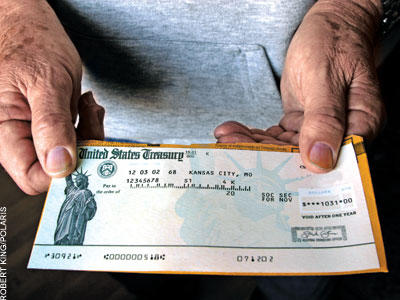 I hate Social Security. I hate the idea of the government taking money form me in order to serve my "best" interest in the belief that I'm too stupid to be able to save my own money (Probably true for most Americans but I should not be punished for the actions of stupid people). But this is not what this post is about. This is about the Tax that they take from you every paycheck. It is a truly evil tax.
1. It is the largest tax most people pay - Yes it is, even higher than most people's federal income tax. That's because not only do you have to pitch in your 7.5% but so does your employer, effectively making it a 15% tax. And it isn't a marginal rate. (You have to earn just under $35,000 for it to break even)
2. It's a stealth tax - You probably don't think about the above reason and thus, completely ignore how large the tax really is.
3. Taxing you multiple times - You pay income tax on your contribution to social security yet NEVER see the money. That's right, your social security contribution is not taken away from your taxable income, thus you pay taxes on it even though you never saw the money. Then, when you actually receive your Social Security check, (if you get that old) you are taxed again.
4. It encourages the government to overspend - since the government currently takes in much more in Social Security than it pays out it is an incentive for the federal government to spend more now since the deficits don't look as big as they actually are. Of course all this does is delay the inevitable, taxes must always equal government expenditures either now or later.
5. It's regressive - That's right. It hurts the poor, the very people the program is supposed to help. How can this be? Because there is a cap on the maximum amount you can be taxed on, about $90,000. After that, you stop paying social security tax. That effectively drops your tax rate by 7.5% as soon as you enter this income bracket (even more considering your employer doesn't have to pay his half either)
This system just keeps giving me more reasons to not like it.
Problems with the tax code
Friday, April 15, 2005
Today is the only day that millions of Americans actually are happy that either money was taken away from them or angry that it was given to them.
Of course I'm talking about taxes. Most of my readers realize that getting a tax return amounts to the government just taking money throughout the year form you, money that is rightfully yours, and giving it back, interest free, several months later. The opposite is true if you have to pay taxes, you got money interest free from the government for the year. I'm not going to say anything more about this.
I honestly believe something must be done to simplify the tax code. I don't know if I support Bush's plan, but something must me done. United States citizens pay over $135 Billion complying with the tax code. That is money not used for other more productive activities.
This subject really interest me. I'm reading a book called Perfectly Legal which talks about how the super rich can get away with paying no taxes, and most of it is perfectly legal. I don't agree with everything with the book, the book has its obvious biases, but it brings up some interesting point.
This is a very complex issue, one that doesn't have many solutions. My own take is this. You can't fix the current tax structure because
1. It is progressive - This actually causes a lot more problems then people think. The arguments against a flat tax is that it adversely affects the poor and families. There is some truth in this but there it isn't the whole story. Do people realize that deductions in a progressive tax code benefit the rich more? So the deduction you get for your mortgage interest is worth even more to someone who is rich.
2. There are too many exemptions - this overly complicates the code and creates huge loopholes. Doing away with this will cause its own problems. Families who have enjoyed credits for having children and deductions for medical care and mortgage payments would see these vanish and would probably cry bloody murder. However, the rich are even better at exploiting these exemptions. People just don't look outside there own situation. Ever dollar that someone else is able to avoid is another dollar someone else has to pay. Not only that that person spent some money paying someone to avoid that tax and the government probably paid someone to see if the deduction is actually valid.
3. They tax income. Do people realize how easy it is for the rich to hide income? Do people realize that the rich get a lot of their income from capital gains which is taxed at a much lower level? I find it laughable that many people praise the Google founders for only taking $1 in salary. People think they are doing a charitable thing. Do people realize this was probably done to avoid paying taxes? Money that the rest of the tax paying public will have to make up?
Taxing income, in my mind, is just a bad idea. Of course there is the argument that taxing anything else will adversely affect the poor. I swear to people that these are rich people feeding this to others that this is a bad idea. The argument goes that poor people spend a greater percentage of their income and thus will have a larger burden. However, taxation is a complex situation. Knowing who actually shares the burden can never be known because it depends how the burden is shifted. I won't get into a deep economic discussion here but believe me, you can not tell who is paying the tax even if there is seemingly no tax on an item. If you really must keep appearances up you can simply do what all the states do, don't tax necessities like food, clothing (in some states), etc. Items that poor people spend a majority of their money on. (I think not taxing necessities would be a bad idea for reasons I won't get into)
4. Government is too big. We need to just restrict government spending. Its getting out of hand. We tax because we expect government to provide a million different services, all of which cost money. Of course we as individuals don't see the big picture and figure our little program, whether it be lowering capital gains or saving the rain forest, isn't going to make a dent in the trillion dollar federal budget. Yeah, and buying that Starbuck's Espresso everyday isn't going to make a big difference either.
What is my solution? I'm not sure yet. I'm still thinking about it. I just know I don't like what we have. In summary, the more complex the tax code the more expensive it is to comply with, the more inefficient it is at collecting taxes, and the easier it is for the rich to avoid taxes.
OK, I've babbled long enough. The point is, I hate tax day. I hate giving my money to the government so that it can be wasted on some program I don't care about, will never use, or to pay for some $1000 hammer or something.
Of course I'm talking about taxes. Most of my readers realize that getting a tax return amounts to the government just taking money throughout the year form you, money that is rightfully yours, and giving it back, interest free, several months later. The opposite is true if you have to pay taxes, you got money interest free from the government for the year. I'm not going to say anything more about this.
I honestly believe something must be done to simplify the tax code. I don't know if I support Bush's plan, but something must me done. United States citizens pay over $135 Billion complying with the tax code. That is money not used for other more productive activities.
This subject really interest me. I'm reading a book called Perfectly Legal which talks about how the super rich can get away with paying no taxes, and most of it is perfectly legal. I don't agree with everything with the book, the book has its obvious biases, but it brings up some interesting point.
This is a very complex issue, one that doesn't have many solutions. My own take is this. You can't fix the current tax structure because
1. It is progressive - This actually causes a lot more problems then people think. The arguments against a flat tax is that it adversely affects the poor and families. There is some truth in this but there it isn't the whole story. Do people realize that deductions in a progressive tax code benefit the rich more? So the deduction you get for your mortgage interest is worth even more to someone who is rich.
2. There are too many exemptions - this overly complicates the code and creates huge loopholes. Doing away with this will cause its own problems. Families who have enjoyed credits for having children and deductions for medical care and mortgage payments would see these vanish and would probably cry bloody murder. However, the rich are even better at exploiting these exemptions. People just don't look outside there own situation. Ever dollar that someone else is able to avoid is another dollar someone else has to pay. Not only that that person spent some money paying someone to avoid that tax and the government probably paid someone to see if the deduction is actually valid.
3. They tax income. Do people realize how easy it is for the rich to hide income? Do people realize that the rich get a lot of their income from capital gains which is taxed at a much lower level? I find it laughable that many people praise the Google founders for only taking $1 in salary. People think they are doing a charitable thing. Do people realize this was probably done to avoid paying taxes? Money that the rest of the tax paying public will have to make up?
Taxing income, in my mind, is just a bad idea. Of course there is the argument that taxing anything else will adversely affect the poor. I swear to people that these are rich people feeding this to others that this is a bad idea. The argument goes that poor people spend a greater percentage of their income and thus will have a larger burden. However, taxation is a complex situation. Knowing who actually shares the burden can never be known because it depends how the burden is shifted. I won't get into a deep economic discussion here but believe me, you can not tell who is paying the tax even if there is seemingly no tax on an item. If you really must keep appearances up you can simply do what all the states do, don't tax necessities like food, clothing (in some states), etc. Items that poor people spend a majority of their money on. (I think not taxing necessities would be a bad idea for reasons I won't get into)
4. Government is too big. We need to just restrict government spending. Its getting out of hand. We tax because we expect government to provide a million different services, all of which cost money. Of course we as individuals don't see the big picture and figure our little program, whether it be lowering capital gains or saving the rain forest, isn't going to make a dent in the trillion dollar federal budget. Yeah, and buying that Starbuck's Espresso everyday isn't going to make a big difference either.
What is my solution? I'm not sure yet. I'm still thinking about it. I just know I don't like what we have. In summary, the more complex the tax code the more expensive it is to comply with, the more inefficient it is at collecting taxes, and the easier it is for the rich to avoid taxes.
OK, I've babbled long enough. The point is, I hate tax day. I hate giving my money to the government so that it can be wasted on some program I don't care about, will never use, or to pay for some $1000 hammer or something.
Special Tax for Wal-mart
Wednesday, February 16, 2005
Before I start, let me tell people who do not normally read my blog this: I do not shop at Wal-mart. I'm not a particular fan of their policies and hiring practices. I hate their stores because they are warehouse like and often very dark and dirty. But I choose to combat Wal-mart in the best possible way, I don't shop there.
But now there is a bill in Montana to tax retailers who do more than $20 Million in sales. Basically, the more successful you are the more you are going to have to pay. It takes aim squarely at Wal-mart, and to some extent Target and Costco, whose critics complain that they pay their workers so little that it is up to the public to subsidize the workers' meager wages.
Now my first take, two wrongs don't make a right. The real problem is that you expect everybody else to subsidize lower paid workers. If there is no social welfare then there is no problem. However, this is a very long topic in and of itself and I don't really wish to argue this point right now.
OK, so lets just take social welfare programs as a given. Is it a good idea to tax Wal-mart? The impetus behind this is to presumably help those who Wal-mart is underpaying. Does it really? Any economist will tell you that in truth, the effect is unknown. Take this scenario.
Faced with higher taxes Wal-mart does what any business does, it tries to maximize profit. Taxes always have some effect on behavior because it changes the relative cost of doing business. It will probably either
a) cut costs, most likely through wages and benefits since this is most businesses biggest and most flexible expense.
b) raise prices
Neither is good for the people the tax is trying to help. For those who hate Wal-mart and believe it is the devil, have you actually shopped at one? Do you see the people who go there? Most are struggling families who go to Wal-mart because its prices are so low it allows them to stretch their dollar that much farther. Raise prices and you directly hurt those who need it the most.
I am sure there will now be arguments that Wal-mart created this class in the first place by paying their workers so little that they can only afford to shop at their stores. Take a good look. Wal-mart is huge; millions and millions of people shop there, much more than are employed by Wal-mart. But that isn't even the point. Even if Wal-mart created this class I have less of a problem with that than the government fixing the problem through taxation. I have to agree with the Wal-Mart spokesman, government should not pick winners and losers in business. If you allow government to pick on the biggest kid on the block, what is next? What is to stop them from taxing the 2nd biggest kid, and then the 3rd? As soon as #1 is taxed into oblivion and #2 becomes #1 what happens then?
So lets stop Wal-mart the right way. STOP SHOPPING THERE! Tell your friends, spread the word. Evangelisize Target. Lets just not do it by having government do the dirty work.
But now there is a bill in Montana to tax retailers who do more than $20 Million in sales. Basically, the more successful you are the more you are going to have to pay. It takes aim squarely at Wal-mart, and to some extent Target and Costco, whose critics complain that they pay their workers so little that it is up to the public to subsidize the workers' meager wages.
Now my first take, two wrongs don't make a right. The real problem is that you expect everybody else to subsidize lower paid workers. If there is no social welfare then there is no problem. However, this is a very long topic in and of itself and I don't really wish to argue this point right now.
OK, so lets just take social welfare programs as a given. Is it a good idea to tax Wal-mart? The impetus behind this is to presumably help those who Wal-mart is underpaying. Does it really? Any economist will tell you that in truth, the effect is unknown. Take this scenario.
Faced with higher taxes Wal-mart does what any business does, it tries to maximize profit. Taxes always have some effect on behavior because it changes the relative cost of doing business. It will probably either
a) cut costs, most likely through wages and benefits since this is most businesses biggest and most flexible expense.
b) raise prices
Neither is good for the people the tax is trying to help. For those who hate Wal-mart and believe it is the devil, have you actually shopped at one? Do you see the people who go there? Most are struggling families who go to Wal-mart because its prices are so low it allows them to stretch their dollar that much farther. Raise prices and you directly hurt those who need it the most.
I am sure there will now be arguments that Wal-mart created this class in the first place by paying their workers so little that they can only afford to shop at their stores. Take a good look. Wal-mart is huge; millions and millions of people shop there, much more than are employed by Wal-mart. But that isn't even the point. Even if Wal-mart created this class I have less of a problem with that than the government fixing the problem through taxation. I have to agree with the Wal-Mart spokesman, government should not pick winners and losers in business. If you allow government to pick on the biggest kid on the block, what is next? What is to stop them from taxing the 2nd biggest kid, and then the 3rd? As soon as #1 is taxed into oblivion and #2 becomes #1 what happens then?
So lets stop Wal-mart the right way. STOP SHOPPING THERE! Tell your friends, spread the word. Evangelisize Target. Lets just not do it by having government do the dirty work.
January Reminds People to Vote Republican
Tuesday, February 01, 2005
This is what the Democrats don't get. Every January people are reminded why it is better to be a Republican.
I did my taxes yesterday. I payed A LOT of taxes this past year. A LOT. I paid more taxes this year than most people earn. I paid enough in taxes to buy a new car, a NICE car. While that is good in the sense that I earned a lot of money, it strikes me as terribly unfair.
I am not rich. I earn a good living but few people could argue that I live an extravagent lifestlye. I take very little from others. I have never claimed unemployment, I have never been on welfare, and I don't get any tax breaks for being married, having children, or owning my own home. Yet somehow I am deemed the one best suited to pay for all of this. My virtue, the fact I pulled myself up and have never asked for anything, makes me the one who must bear the greatest burden.
Am I being selfish? Absolutely. But few people who know me would think I am. I donate my time to good causes when I can, I donate to charity every year, and I'm an honest man. I worked hard and sacrificed a lot to be in the position I am. I studied hard, didn't party in school, and squeezed every penny so I can have something for later. I don't mind giving to others since I have a lot but shouldn't I be able to take care of myself and my loved ones first? Why must I care for other people's children and families first before I care for mine?
Yes I know, Republicans spend a lot of money and the budget rose the fastest under W. But the fact remains that the Republican platform is for smaller government, lower taxes, and ensuring that everyone is a Christian. OK, the last part I can't get on board with but everything else sounds good to me.
I have always voted Democrat. I believed that no price was too high to ensure personal freedom; that was until I started paying the bill.
I did my taxes yesterday. I payed A LOT of taxes this past year. A LOT. I paid more taxes this year than most people earn. I paid enough in taxes to buy a new car, a NICE car. While that is good in the sense that I earned a lot of money, it strikes me as terribly unfair.
I am not rich. I earn a good living but few people could argue that I live an extravagent lifestlye. I take very little from others. I have never claimed unemployment, I have never been on welfare, and I don't get any tax breaks for being married, having children, or owning my own home. Yet somehow I am deemed the one best suited to pay for all of this. My virtue, the fact I pulled myself up and have never asked for anything, makes me the one who must bear the greatest burden.
Am I being selfish? Absolutely. But few people who know me would think I am. I donate my time to good causes when I can, I donate to charity every year, and I'm an honest man. I worked hard and sacrificed a lot to be in the position I am. I studied hard, didn't party in school, and squeezed every penny so I can have something for later. I don't mind giving to others since I have a lot but shouldn't I be able to take care of myself and my loved ones first? Why must I care for other people's children and families first before I care for mine?
Yes I know, Republicans spend a lot of money and the budget rose the fastest under W. But the fact remains that the Republican platform is for smaller government, lower taxes, and ensuring that everyone is a Christian. OK, the last part I can't get on board with but everything else sounds good to me.
I have always voted Democrat. I believed that no price was too high to ensure personal freedom; that was until I started paying the bill.
Taxing the Rich: Part 2
Friday, November 19, 2004
This is a follow up to my original post that asked the question whether it really is a good idea to tax the rich more heavily. There are many people who have the idea that the rich will just grin and bear it and won’t alter their behavior if we as a society decide to tax them more. They, after all, have the ability to pay and will just continue to work hard no matter how much the rest of society decides to tax them. I had several interesting conversations this past weekend that would say otherwise.
While visiting some friends this weekend I had conversations with several people looking for jobs after they graduate from Harvard Business School. Most HBS grads can be fairly certain of receiving job offers in the six-figure range and of course this salary has the potential to grow very rapidly in the succeeding years. These graduates, and others from various MBA programs, are the drivers of the economy. Many will start business that will create billions of dollars and provide jobs for thousands of workers. At the very least, their salaries will provide much needed spending and tax revenues wherever they decide to live.
On more than one occasion a student told me they were looking at job opportunities on the West Coast. Mainly California and Seattle. Many of those students said that they were leaning toward Seattle for the simple reason that taxes were lower and that their prospective job offers from the companies in California did not reflect the added cost of living. After you factor in California’s Income Tax, High Sales Tax, and High Property tax you have to earn a lot more than you would in a state like Washington that has no Income Tax.
So those who argue that raising taxes will have no noticeable impact on the rich need to think hard about what they believe is right. My stance on this issue isn't because I'm greedy for myself. If these students and others like them decide to move to a different state they take their income, and all their tax dollars with them. In the end, you are just hurting the poor you are desperately trying to help.
While visiting some friends this weekend I had conversations with several people looking for jobs after they graduate from Harvard Business School. Most HBS grads can be fairly certain of receiving job offers in the six-figure range and of course this salary has the potential to grow very rapidly in the succeeding years. These graduates, and others from various MBA programs, are the drivers of the economy. Many will start business that will create billions of dollars and provide jobs for thousands of workers. At the very least, their salaries will provide much needed spending and tax revenues wherever they decide to live.
On more than one occasion a student told me they were looking at job opportunities on the West Coast. Mainly California and Seattle. Many of those students said that they were leaning toward Seattle for the simple reason that taxes were lower and that their prospective job offers from the companies in California did not reflect the added cost of living. After you factor in California’s Income Tax, High Sales Tax, and High Property tax you have to earn a lot more than you would in a state like Washington that has no Income Tax.
So those who argue that raising taxes will have no noticeable impact on the rich need to think hard about what they believe is right. My stance on this issue isn't because I'm greedy for myself. If these students and others like them decide to move to a different state they take their income, and all their tax dollars with them. In the end, you are just hurting the poor you are desperately trying to help.
Why Taxing the Rich More may be a BAD Idea
Thursday, October 28, 2004
There is a proposition on the California Ballot, Proposition 63, that will increase the tax of people who make over $1million dollars by 1%. This would raise approximately $750 Million a year by taxing only about 25,000 to 30,000 people No big deal right? Sounds like a great deal "Because they have the capacity to pay it." It looks like it is going to pass. I'm here to tell you what a really bad idea this may be.
Imagine you are a very hard worker at your company and you are the best at what you do. While most people work 32-40 hours a week you voluntarily work 80 hours a week. You make a little more money than most, not twice as much but you like your job and you don't mind much. You know that your hard work will help everybody in the long run by making the company more successful.
Now the company decides to implement a new policy. It tells you that all the best workers are required to work more hours. Not a lot more just a little. It shouldn't be a big deal "Because you have the capacity to do it" Those who don't have the capacity, the people working 32-40 hours, actually will get to work less. They tell you that you are now REQUIRED to work 84 hours, just 5% more than you are currently working. Because you are good at what you do and so much more productive than everyone else everyone else gets to work 2 hours less.
Great plan right. I mean only the people who have the ability are affected. Everyone else, those without ability, get to live a slightly easier and better life. Why should you care? You can handle the extra small burden.
What would you do? I know I would leave the company and find new work. Where does that leave everybody? The company just lost one of its best workers who not only worked harder but also was more productive. That means everybody has to work HARDER now, 40-48 hours, than they did before or the company will do worse. Even a bigger problem is that most likely it doesn't matter how much harder everyone works, there are certain things that only you can do. No matter how hard I work, no way can I do the creative work of the Graphic Designer just like no way can the Graphic Designer come up with an elegant software architecture.
But it's only a little! The problem is that there is a domino effect. It takes one hard worker leaving the company. Let's say that is someone else. Well then production for the whole company goes down. What happens? Well, why don't we just make the most productive work a little harder? It’s only a little. What is another 5% right? So now you are working 88 hours. See the problem?
People sometimes say I lack compassion because I don't believe in helping the poor at all cost. I say that these people don't have a view of the larger problem. What happens to those without ability when the company goes under? How will they find more work? It's probably not a big deal for the hard workers to find new jobs but what about those that are not as hard working? Who was really hurt because you decided to ask for more from those most able? Have the people who said this ever had to lay someone off? It isn't fun. So who lacks compassion?
Think about it.
Imagine you are a very hard worker at your company and you are the best at what you do. While most people work 32-40 hours a week you voluntarily work 80 hours a week. You make a little more money than most, not twice as much but you like your job and you don't mind much. You know that your hard work will help everybody in the long run by making the company more successful.
Now the company decides to implement a new policy. It tells you that all the best workers are required to work more hours. Not a lot more just a little. It shouldn't be a big deal "Because you have the capacity to do it" Those who don't have the capacity, the people working 32-40 hours, actually will get to work less. They tell you that you are now REQUIRED to work 84 hours, just 5% more than you are currently working. Because you are good at what you do and so much more productive than everyone else everyone else gets to work 2 hours less.
Great plan right. I mean only the people who have the ability are affected. Everyone else, those without ability, get to live a slightly easier and better life. Why should you care? You can handle the extra small burden.
What would you do? I know I would leave the company and find new work. Where does that leave everybody? The company just lost one of its best workers who not only worked harder but also was more productive. That means everybody has to work HARDER now, 40-48 hours, than they did before or the company will do worse. Even a bigger problem is that most likely it doesn't matter how much harder everyone works, there are certain things that only you can do. No matter how hard I work, no way can I do the creative work of the Graphic Designer just like no way can the Graphic Designer come up with an elegant software architecture.
But it's only a little! The problem is that there is a domino effect. It takes one hard worker leaving the company. Let's say that is someone else. Well then production for the whole company goes down. What happens? Well, why don't we just make the most productive work a little harder? It’s only a little. What is another 5% right? So now you are working 88 hours. See the problem?
People sometimes say I lack compassion because I don't believe in helping the poor at all cost. I say that these people don't have a view of the larger problem. What happens to those without ability when the company goes under? How will they find more work? It's probably not a big deal for the hard workers to find new jobs but what about those that are not as hard working? Who was really hurt because you decided to ask for more from those most able? Have the people who said this ever had to lay someone off? It isn't fun. So who lacks compassion?
Think about it.
The Brilliant Bush Tax Cut
Wednesday, June 25, 2003
So I just received the first benefit of Bush's Jobs and Growth Act of 2003. I got a whole $30 more in my paycheck. Big Deal.
Over the course of the year that means I will have saved $720. That is the keyword SAVE. This is why Bush's tax plan makes absolutely no sense to me. Do I really feel richer with my additional $30 twice a month? Not really. Do I really plan on spending this new found money on anything? Not really. The money will go nicely away somewhere in the computers of my bank.
Maybe its because I don't have a family and I have the ability to save a lot every month. I understand that most people my age aren't in the position to save very much money and would welcome the extra cash. Those with families, struggling and in my income bracket probably really do need the relief. But that being said, if those familes are really struggling how about those who earn minimum wage? How about those who struggle to get by and make 1/4 or even 1/5 of what I make. How do you think they feel? Trust me, I know. My mom raised 3 kids on her own and put me through college on 1/3 of what I make today. Why don't you just give her some more money back?
Maybe I'm more magnanimous than most but come on people. Let's forget the human part of my argument for a second. After this, it's basic economic theory. My marginal propensity to consume is MUCH lower than someone like my mother. I MIGHTspend $10 of my new found $60 a month. Someone who is poor? They WILL spend all $60. However, for a cut this small I probably won't spend ANY of that $60. So I, the "rich" (I don't consider myself wealthy but in this context I would have to be), really do just get richer. And or course this doesn't at all help the economy now since I'm not consuming any more. It doesn't help the economy later because we just put ourselves into a bigger deficit in the future.
I'm not promoting communism, quite the contrary. I'm probably the biggest Capitalist and fan of Adam Smith there is. Let's just be honest with ourselves. If you want to help the wealthy fine, but don't cloak it behind the charade of trying to stimulate the economy. Clearly there are better ways to do that than with this bogus tax cut.
Over the course of the year that means I will have saved $720. That is the keyword SAVE. This is why Bush's tax plan makes absolutely no sense to me. Do I really feel richer with my additional $30 twice a month? Not really. Do I really plan on spending this new found money on anything? Not really. The money will go nicely away somewhere in the computers of my bank.
Maybe its because I don't have a family and I have the ability to save a lot every month. I understand that most people my age aren't in the position to save very much money and would welcome the extra cash. Those with families, struggling and in my income bracket probably really do need the relief. But that being said, if those familes are really struggling how about those who earn minimum wage? How about those who struggle to get by and make 1/4 or even 1/5 of what I make. How do you think they feel? Trust me, I know. My mom raised 3 kids on her own and put me through college on 1/3 of what I make today. Why don't you just give her some more money back?
Maybe I'm more magnanimous than most but come on people. Let's forget the human part of my argument for a second. After this, it's basic economic theory. My marginal propensity to consume is MUCH lower than someone like my mother. I MIGHTspend $10 of my new found $60 a month. Someone who is poor? They WILL spend all $60. However, for a cut this small I probably won't spend ANY of that $60. So I, the "rich" (I don't consider myself wealthy but in this context I would have to be), really do just get richer. And or course this doesn't at all help the economy now since I'm not consuming any more. It doesn't help the economy later because we just put ourselves into a bigger deficit in the future.
I'm not promoting communism, quite the contrary. I'm probably the biggest Capitalist and fan of Adam Smith there is. Let's just be honest with ourselves. If you want to help the wealthy fine, but don't cloak it behind the charade of trying to stimulate the economy. Clearly there are better ways to do that than with this bogus tax cut.
Rich People Do Have a Heart
Tuesday, May 20, 2003
I was very impressed by a statment made by Warren Buffet. For those who don't know who he is he is the head of Berkshire Hathaway which is basically one of the most successful investment companies on the planet. He is known to be an absolute genius when it comes to picking stocks and is probably rivaled by only Bill Gates as the richest man in America.
Anyway, Buffet recently commented on the proposed tax break on dividends that recently passed through the senate. Now you would think for someone so deeply invested in the stock market that Buffet would be all over this tax break. Afterall, he stands to gain millions if this bill goes through. But he actually came out against it. I couldn't believe my eyes when I read it. A rich capitalist with a soul. (Actually, who am I to call him a rich capitalist?) Read the article. He actually makes a very cogent argument. Everyone and their brother knows this will only benefit the rich but somehow Bush and the republicans want to make it seem like they care for the poor. How many poor people do you know own stock?
Anyway, Buffet recently commented on the proposed tax break on dividends that recently passed through the senate. Now you would think for someone so deeply invested in the stock market that Buffet would be all over this tax break. Afterall, he stands to gain millions if this bill goes through. But he actually came out against it. I couldn't believe my eyes when I read it. A rich capitalist with a soul. (Actually, who am I to call him a rich capitalist?) Read the article. He actually makes a very cogent argument. Everyone and their brother knows this will only benefit the rich but somehow Bush and the republicans want to make it seem like they care for the poor. How many poor people do you know own stock?
Subscribe to:
Posts (Atom)
